Portfolio rebalancing: get back to your plan
Five years ago you made a plan: 70 % in shares, 30 % safe in a savings account. You haven't changed anything since. Yet your portfolio today is a different one. It has become riskier without you noticing.
The reason is simple. Shares usually grow faster than cash, so their share of the whole grows year by year. Portfolio rebalancing is the routine that brings your portfolio back to your plan. After this article you'll know when it pays off, how often to do it and how it often works without selling and without tax.

Updated on 8 November 2026 · 8 min read
Contents
- What is portfolio rebalancing?
- Why your portfolio gets riskier without rebalancing
- Rebalancing example: step by step
- Option 1: sell and move
- Option 2: use your monthly savings
- And when prices fall?
- How often should you rebalance your portfolio?
- Rebalancing and taxes
- Do you even need to rebalance?
- Done in 10 minutes
- Do you know how your portfolio is split right now?
What is portfolio rebalancing?
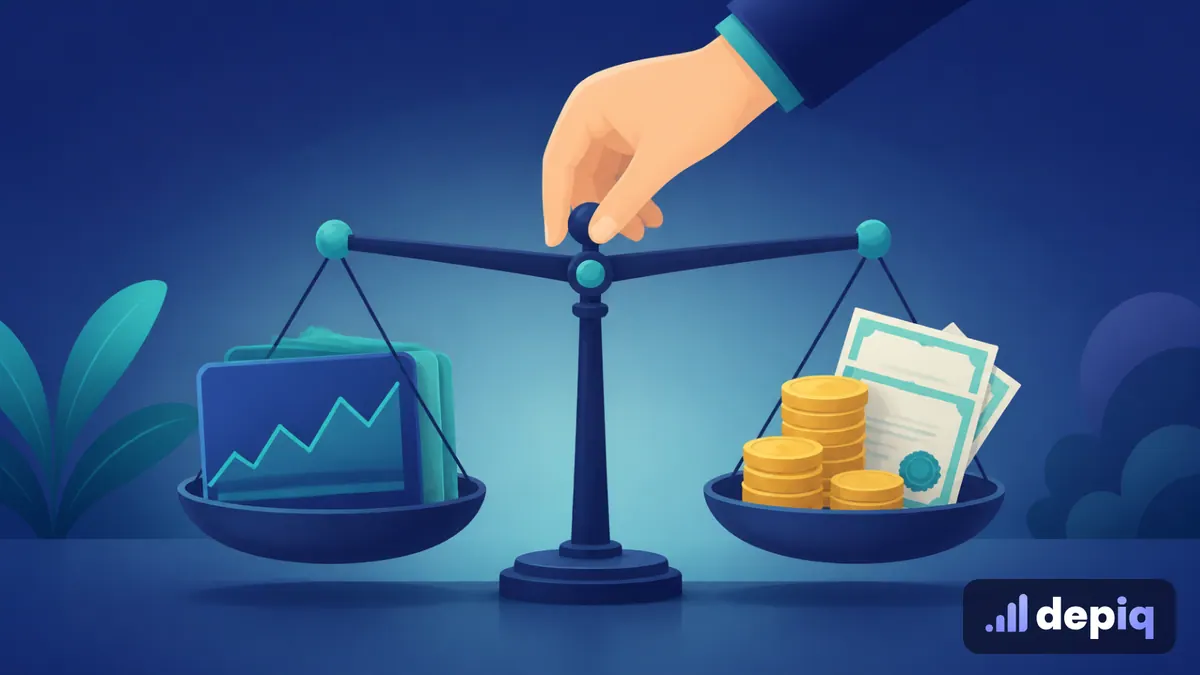
Picture your portfolio as a scale with two pans. One holds the part that may fluctuate and should grow over time, usually an equity ETF. An ETF is a basket of shares in hundreds of companies that you get with a single purchase. The other pan holds the calm part: cash in an instant-access savings account, or bonds. Bonds are loans you give to a government or a company in return for interest, and they move far less than shares.
How much sits in each pan is called your asset allocation. It is the most important decision in investing, because it determines how much your portfolio swings and how much it can earn over time.
Rebalancing literally means restoring the balance. When the scale tips because one pan has become heavier, you move something across until it sits the way you planned.
Why your portfolio gets riskier without rebalancing
Shares usually earn more than cash over the long run. That is good, but it has a side effect: their weight in your portfolio grows on its own. A portfolio you once planned as balanced slowly turns into a share portfolio.
An example with round numbers: 7,000 € in an equity ETF and 3,000 € in cash, so 70 to 30. Shares grow 6 % a year, cash 2 %. You do nothing.
Share portion without rebalancing (start 70 %, shares 6 %, cash 2 % a year assumed)
| Item | Value |
|---|---|
| Start | 70 % |
| After 5 years | 74 % |
| After 10 years | 77 % |
| After 20 years | 83 % |
| Goal | 100 % |
Worked example, rounded, not guaranteed. Real prices fluctuate a lot.
After 20 years about 83 % sits in shares instead of 70 %. A market fall then hits you much harder than you planned for, often just when you need the money soon, for example shortly before retirement.
Rebalancing example: step by step
Florina is a made-up example. She has invested 20,000 €: 14,000 € in a global ETF and 6,000 € in a savings account, so 70 to 30. She adds 300 € every month.
After a good year her shares are up 20 % and her savings account has paid 2 % interest.
| Equity ETF | Cash | Total | Share portion | |
|---|---|---|---|---|
| Start | 14,000 € | 6,000 € | 20,000 € | 70 % |
| After a good year | 16,800 € | 6,120 € | 22,920 € | 73 % |
| Target 70 to 30 | 16,044 € | 6,876 € | 22,920 € | 70 % |
Worked example, rounded, not guaranteed.
To get back to 70 to 30, Florina would need to move about 760 € from the ETF to cash. She has two options.
Option 1: sell and move
She sells ETF units worth about 760 € and moves the money to her savings account. It's quick, but it can cost fees and tax because she is selling at a profit.
Option 2: use your monthly savings
She leaves the ETF alone and puts her 300 € a month into cash only, for a few months. Without new price moves, the split would be back at 70 to 30 after about four months. Then her ETF savings plan continues as usual. She sold nothing, so no tax and no selling fees.
And when prices fall?
Now the reverse. Say Florina's shares drop 30 % in a bad year. 14,000 € become 9,800 €, cash stands at 6,120 €. Her share portion is down to about 62 %.
Rebalancing now means moving about 1,340 € from cash into the ETF, buying shares while many others are selling. In the middle of a crisis that feels wrong. Yet that is exactly what the rule is for: it has you buy when prices are low and take some profit when they are high. It decides in place of gut feeling and fear.
That is what the calm part of your portfolio is for. It barely moves and gives you money to rebalance in a downturn without touching your emergency fund.
How often should you rebalance your portfolio?
More often is not better. Rebalancing every month mostly costs fees and possibly tax. Three simple rules have proven themselves, and you can combine them.
| Rule | How it works | Good for |
|---|---|---|
| Calendar | Check once a year on a fixed date, such as your birthday | anyone who wants it simple |
| Threshold | Act only when a part is more than 5 percentage points off target | anyone who wants a bit more precision |
| New money | Keep directing contributions into the part that is too small | anyone who saves regularly |
The limit in the second rule is often called a tolerance band: the range in which you do nothing. A percentage point is simply the distance between two percentages, so from 70 % to 73 % is 3 percentage points.
For Florina: after the good year she is only 3 points above target, so under the 5-point rule she does nothing yet. After the bad year she is about 8 points below. Now her rule kicks in.
Rebalancing and taxes
Tax only comes into play when you sell at a profit. Rebalancing with new money never triggers it. If you do sell, the rules depend on your country. A few examples from German-speaking Europe, as of 8 November 2026:
| Country | Tax on gains when you sell | Allowance |
|---|---|---|
| Germany | about 26 % (flat rate plus solidarity surcharge) | 1,000 € per person and year |
| Austria | 27.5 % | none |
| Switzerland | private capital gains usually tax-free | – |
Basic rules, not tax advice. Elsewhere, check your local rules before you sell.
In practice: where every profitable sale is taxed, as in Austria, rebalancing with new money is especially useful. In Switzerland, very frequent trading can lead the tax office to treat you as a professional trader, and then gains become taxable.
Do you even need to rebalance?
Not everyone does. If you hold a single ETF covering the whole world and no calm part, the ETF takes care of the weights of companies and countries itself. There is nothing to rebalance. How to set up such a plan is covered in ETF savings plan for beginners.
Rebalancing matters once your portfolio has at least two building blocks: an equity ETF plus cash, an equity ETF plus bonds, or a global ETF plus an emerging markets ETF. The bigger your portfolio, the more money hides behind a few percentage points of drift.
It also matters more the closer you get to needing the money. With 30 years ahead you can sit out a fall. With three years to retirement, the same oversized share portion can upset your plans. Why time matters so much is explained in compound interest.
Done in 10 minutes
- Write down your target split, for example "70 % equity ETF, 30 % cash".
- Work out today's actual split: the value of each part divided by the total.
- If a part is more than 5 percentage points off, direct your next contributions into the part that is too small.
- Put a fixed yearly date in your calendar to repeat this.
- Use the savings plan calculator to see what your monthly amount adds up to over the years.
Do you know how your portfolio is split right now?
Money often sits in several places: a brokerage account here, a savings account there, an old fund savings plan somewhere else. Then hardly anyone knows how the scale really stands, and rebalancing turns into guesswork.
My book "Depot-IQ" shows you how to set your allocation and keep it on track, step by step, in plain language (about the book). The English edition is in the works, and the depiq app is coming in English too.
This article is not investment advice. It explains the basics and does not replace personal advice. All figures are worked examples; past performance is no guarantee of future results. Sources: Finanztip, rebalancing, Finanzfluss, ETF rebalancing.

My book “Depot-IQ”: over 500 pages in full colour, explained simply, with no buy or sell tips.
Questions about this topic
What is portfolio rebalancing in simple terms?
Rebalancing means bringing your portfolio's split back to your plan from time to time. If you planned 70 % shares and 30 % cash and shares have risen strongly, you move some money back until 70 to 30 is right again.
How often should I rebalance?
For most people a check once a year on a fixed date is enough. Act only when a part is more than about 5 percentage points away from your target. Rebalancing more often mostly adds fees and taxes.
Can I rebalance without selling?
Yes. Direct your new monthly savings into the part that has become too small until the split is right again. You sell nothing, so there is no tax on gains and no selling fee.
Do I pay tax when I rebalance?
Only if you sell at a profit. How much depends on where you live. In Germany the first 1,000 € of investment income per person and year is tax-free, in Austria there is a flat 27.5 % with no allowance, and in Switzerland private capital gains are usually tax-free.
Do I need to rebalance with just one ETF?
With a single global ETF and no safe part, usually not. The ETF adjusts the weights of companies and countries by itself. Rebalancing matters once you hold two or more building blocks, for example an equity ETF and cash.
What does rebalancing mean after a market fall?
After a fall, your share portion is smaller than planned. Following your rule means moving money from the safe part into shares. It feels hard, and that is the point: the rule decides, not the mood of the day.
Founder of depiq · Stuttgart
I have been investing for over 25 years and know the feeling many investors share: the portfolio is spread across several brokers and the spreadsheet is never up to date. That feeling is where depiq and my book “Depot-IQ” came from: clear instead of complicated, with no buy or sell tips.
- Investing for over 25 years
- Author of “Depot-IQ”
- Founder of depiq