How to open a brokerage account: a beginner's guide
Tim had wanted to invest in ETFs "at some point" for three years. ETFs are funds that hold many shares at once in a single unit. It was never the money that stopped him, it was one question: where do I even start? One Tuesday evening he simply did it. 35 minutes later his account was open. (Tim is a made-up example, and his story runs through this article.)
Opening a brokerage account is much easier today than most people think. Here you'll find what you need, what to look for when choosing, how safe your money is and what to check in your own country. After that you can get going in half an hour.

Updated on 8 November 2026 · 8 min read
Contents
- What is a brokerage account, and why do you need a broker?
- Branch bank, online broker or app broker: which fits you?
- What does a brokerage account really cost?
- How safe is your money with a broker?
- How to open a brokerage account step by step
- Opening an account in Germany, Austria and Switzerland
- What if you want to switch later?
- Done in 10 minutes
- Your first account is the start, not the goal
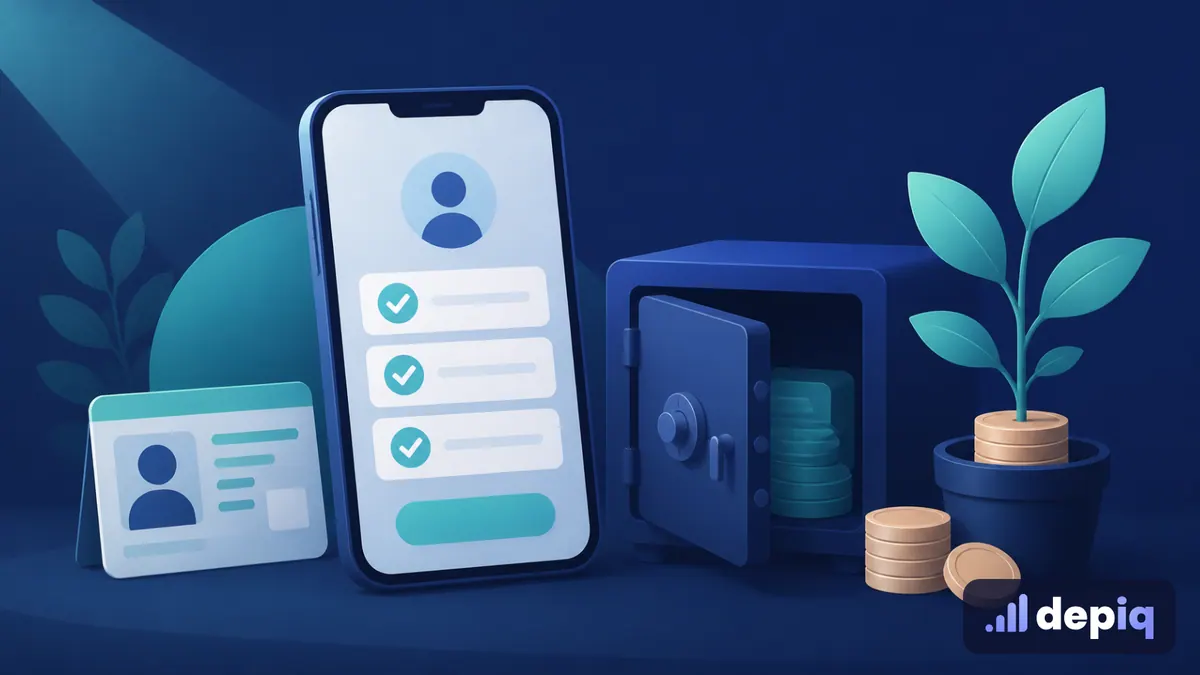
What is a brokerage account, and why do you need a broker?
You can't just walk up to a stock exchange and buy a share. You need someone who carries out the purchase for you, and an account where your securities are held.
The broker is that middleman. It can be a bank or a company that specialises in securities. You give it an order, it buys for you.
The brokerage account is where your securities are kept, the way your current account holds your money.
Almost always it comes with a linked cash account. That is the account money is taken from when you buy, and where it arrives when you sell or receive a payout. Sometimes it is a separate account at the broker, sometimes your normal current account.
Branch bank, online broker or app broker: which fits you?
Roughly, there are three groups. This article deliberately names no providers: prices and offers change constantly, and the right choice depends on you.
| Type | How it works | Costs | A good fit if … |
|---|---|---|---|
| Branch bank | bank with a local branch | usually highest | you want to talk to someone in person |
| Online broker | everything online, no branch | low | you want a wide choice and decide yourself |
| App broker | young provider, everything in an app | often lowest | you want to invest simply from your phone |
App brokers, sometimes called neobrokers, run mainly through a smartphone app. Trades there often cost one euro or nothing, and savings plans are frequently free. In return the range of securities and trading venues can be smaller, and customer service often runs through chat.
At a branch bank you can ask questions face to face, which many people value at the start. Keep in mind that the conversation there is often not neutral advice but a sales talk for products the bank earns money on.
For a simple ETF savings plan, many beginners are well served by a low-cost online or app broker. How to set up your first plan afterwards is covered in ETF savings plan for beginners.
What does a brokerage account really cost?
Adverts often promise "free". Sometimes that's true, sometimes not. In the provider's price list, look for just three numbers.
- Account fee per year
- Cost per buy or sell order
- Cost per savings plan execution
The third one is often underestimated. With a 100 € monthly plan, a 1 € fee per execution is already 1 % of your money, every single month.
Fees alone over 20 years with a 100 € monthly plan
| Item | Value |
|---|---|
| 30 € account fee a year + 1.50 € per execution | 960 € |
| No account fee + 1 € per execution | 240 € |
| No account fee, free savings plan | 0 € |
Worked example: 12 executions a year, not counting returns on the fees saved. The actual pricing is in the provider's price list.
If you factor in that the saved money could itself have been invested and kept growing, the gap gets even bigger. The article on compound interest shows why.
How safe is your money with a broker?
Almost everyone asks this. The answer rests on one simple difference between your securities and your cash.
In the EU and Switzerland, the shares and ETFs in your account legally belong to you, not to the broker. If the provider goes bust, they are not mixed with its own assets but handed back to you or moved to another account. There is no upper limit.
Cash in the linked account is different. It is a balance at a bank, essentially a loan you give it. That is what deposit protection is for: a statutory fund that compensates customers when a bank fails. In the EU it covers up to 100,000 € per person and bank, in Switzerland up to 100,000 Swiss francs. The limit applies per bank, not per account.
None of these rules protect you from one thing: falling prices. That risk is always yours. That's why money you need soon belongs in your emergency fund, not in your brokerage account.
How to open a brokerage account step by step
Tim chose an online broker because it offered his preferred ETF as a free savings plan. This is how it went.
- Enter your details: name, address, date of birth, occupation, and usually a tax identification number.
- Experience questionnaire: the broker is legally required to ask how much you know about securities. Answer honestly. Warnings on some products are completely normal for beginners.
- Confirm your identity, usually by video. You hold your ID up to the camera and either talk briefly to a staff member or get checked automatically. Your ID must be valid.
- Activation: your account and cash account are then active, often the same day, sometimes after a few working days.
- Transfer money: Tim set up a standing order that sends money to his cash account two days after payday. If the cash account is empty, the savings plan is skipped.
Opening an account in Germany, Austria and Switzerland
If you live in one of these countries, a few local points matter.
In Germany, you file a tax exemption order with your broker, an instruction that your investment income up to 1,000 € a year (2,000 € for married couples filing jointly) should stay tax-free. Without it the broker deducts tax right away.
In Austria, investment income is taxed at a flat 27.5 %. The easiest choice is usually a broker with its seat or a branch in Austria, which withholds the tax for you. With a foreign broker you have to calculate and declare everything yourself.
In Switzerland, Swiss brokers charge a small stamp duty on every trade: 0.075 % on Swiss and 0.15 % on foreign securities. All securities also go into your tax return, and many Swiss banks supply a ready-made tax statement for that.
What if you want to switch later?
Your first account doesn't have to be perfect. If after two years another provider suits you better, you can move without selling. This is called a portfolio transfer. You open the new account and request the transfer there. Your purchase data moves too, so tax can be calculated correctly later.
Fees and reporting rules for transfers differ by country. In Germany, for instance, the old bank may not charge for the transfer itself. In Austria, a move to a foreign provider must be reported to the tax office within a month. Clarify beforehand who takes care of it.
Done in 10 minutes
- Pick two or three providers and note the three numbers from their price lists: account fee, cost per trade, cost per savings plan.
- Check whether your preferred ETF is available there as a savings plan.
- Find out how the broker handles tax in your country.
- Have your ID ready and check that it is still valid.
- Look up your tax identification number if your country requires one.
How much you then save each month and what it could grow into, you can work out with the savings plan calculator.
Your first account is the start, not the goal
After his first month Tim realised that deciding had been harder than opening the account. Most people feel the same.
My book "Depot-IQ" takes you from the first account to a clear plan, step by step, in plain language (about the book). The English edition is in the works, and the depiq app is coming in English too.
This article is not investment advice. Information as of 8 November 2026; providers' prices and rules can change. Sources: BaFin, deposit protection, esisuisse, Stiftung Warentest, opening a securities account.

My book “Depot-IQ”: over 500 pages in full colour, explained simply, with no buy or sell tips.
Questions about this topic
What do I need to open a brokerage account?
A valid ID, a smartphone or computer with a camera, your tax number if your country requires it, and a bank account to transfer money from. Filling in the application usually takes about half an hour.
How long does it take to open a brokerage account?
The application usually takes around 30 minutes. Once your identity is confirmed, the account is often active the same day, sometimes after a few working days.
How much does a brokerage account cost?
With many online and app-based brokers the account itself is free. What matters are the fees per trade and per savings plan execution. Branch banks often charge a yearly custody fee and higher trading fees.
App broker or bank: which is better for beginners?
It depends on what matters to you. For a simple ETF savings plan, many beginners are well served by a low-cost online or app broker. If you want to talk to someone in person, a branch bank fits, but check the costs carefully.
Is my money gone if my broker goes bust?
In the EU and Switzerland, the shares and ETFs in your account belong to you and are handed back or transferred. Cash in the linked account is protected up to 100,000 € per person and bank in the EU, and up to 100,000 Swiss francs in Switzerland. None of this protects you from falling prices.
Can I switch brokers later?
Yes. With a portfolio transfer your securities move to the new provider without selling. Your purchase data moves with them, so tax can still be calculated correctly later. Check beforehand which fees and reporting duties apply in your country.
Founder of depiq · Stuttgart
I have been investing for over 25 years and know the feeling many investors share: the portfolio is spread across several brokers and the spreadsheet is never up to date. That feeling is where depiq and my book “Depot-IQ” came from: clear instead of complicated, with no buy or sell tips.
- Investing for over 25 years
- Author of “Depot-IQ”
- Founder of depiq