Emergency fund: how much do you really need? (with example)
Friday, 5:40 pm. The garage calls: timing belt and water pump, 1,400 € in total. You need the car for work on Monday.
There are two versions of this evening. In the first, you open your banking app, see your cushion, pay, and enjoy a perfectly normal Friday. In the second, your account slips into overdraft, and the weekend is ruined before it has even started.
The difference between those two evenings is an emergency fund. It is smaller than most people think. in ten minutes you will know your number, and with a simple plan it can be in your account in under two years.

Updated on 3 November 2026 · 9 min read
Contents
- Why an emergency fund is more than money under the mattress
- Emergency fund: how much do you really need?
- Work out your number in three steps
- Who is fine with three months, and who needs more?
- Employees without big commitments
- Families and single earners
- Self-employed and freelancers
- Homeowners
- In retirement
- What counts as an emergency, and what doesn't?
- Where to keep your emergency fund: safe and available fast
- The emergency fund ladder for larger cushions
- How to build an emergency fund step by step
- Starting on a small budget
- Emergency fund and savings plan side by side
- When you need it: use it without guilt
- Done in 10 minutes
- Clarity makes the difference
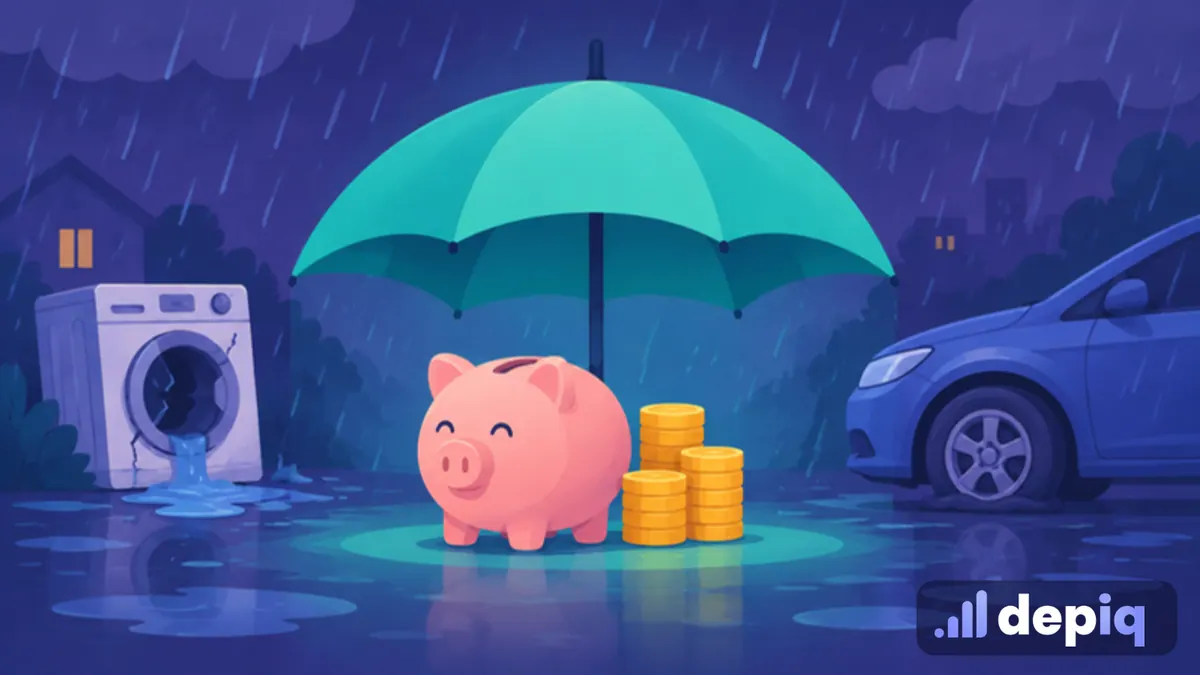
Why an emergency fund is more than money under the mattress
According to a representative 2025 YouGov survey for Postbank, more than one in four German savers could cover their living costs for two months at most. That is nothing to be ashamed of, but it is a risk that is easy to shrink.
An emergency fund does three things for you:
- It makes expensive debt unnecessary. The 1,400 € garage bill costs around 77 € extra in overdraft interest over six months at an assumed 11 %. For nothing.
- It protects your investments. Without a cushion, you may have to sell shares or ETFs in an emergency, possibly right when prices are down.
- It buys you peace of mind. Knowing you can absorb a setback makes you calmer: at work, with investing, in everyday life.
Example: 1,400 € × 11 % × 0.5 years ≈ 77 €. Your actual overdraft rate depends on your bank.
Emergency fund: how much do you really need?
The short answer: three to six months of expenses. German consumer advice centres (Verbraucherzentrale) name two to three months of net pay as a minimum. Many guides plan for three to six months, because one month disappears fast when two things go wrong at once.
The key word is expenses. Not your salary, but what you genuinely need to live. That is almost always less, which makes your goal more achievable.
Work out your number in three steps
- Get your statements: the last three months from online banking, for all accounts.
- Add up the essentials: rent, utilities, insurance, phone, groceries, transport, loan payments. Divide yearly bills by twelve. Leave out holidays, restaurants and shopping; you would cut those in an emergency anyway.
- Multiply by three to six. That's it.
| Essential monthly expenses | 3 months | 6 months |
|---|---|---|
| 1,500 € | 4,500 € | 9,000 € |
| 2,000 € | 6,000 € | 12,000 € |
| 2,500 € | 7,500 € | 15,000 € |
| 3,000 € | 9,000 € | 18,000 € |
Who is fine with three months, and who needs more?
The rule of thumb is a starting point. What suits you depends on how quickly your income could stop and how expensive your typical emergencies are.
Employees without big commitments
With a permanent contract, a second income in the household and no children or home of your own, three months is usually enough. Unemployment insurance often only pays after a few weeks; that is exactly the gap your emergency fund bridges.
Families and single earners
If only one person earns, losing that job or falling ill stops the whole income. Children add costs that can't be postponed. Here, six months is a calmer cushion.
Self-employed and freelancers
Work comes in waves, clients pay late, and there is often no unemployment insurance. That is why six to twelve months are often recommended, kept separate from your business account and from money set aside for tax. The tax reserve is not your emergency fund; it belongs to the tax office.
Homeowners
Roof, heating, windows: repairs on your own home can easily run into five figures. That needs its own reserve next to the emergency fund, or the cushion is gone after the first leak.
In retirement
Your job can no longer disappear, but the dentist, new glasses or a replacement car still arrive. Many retirees keep a larger reserve so they don't have to sell investments during a market crash, when they are worth least.
What counts as an emergency, and what doesn't?
An emergency fund only works if it is used for real emergencies. One question helps: "Would I be in serious trouble without this money?"
| Yes, that's an emergency | No, that deserves its own savings goal |
|---|---|
| Broken washing machine or fridge | A new phone because the old one is slow |
| Car repair when you need the car for work | A holiday, even a cheap one |
| Dentist, glasses, treatment costs | Black Friday deals |
| A back payment for energy or service charges | Christmas presents (they come every year) |
| Income stops until insurance pays | Furniture for a new flat |
Anything you can plan for gets its own small pot, for example a second sub-account for holidays and presents. That way, the emergency fund stays untouched.
Where to keep your emergency fund: safe and available fast
Your emergency fund needs to do two things: be safe and be available quickly. Returns come second. Boring? Yes. And exactly right for this money.
| Where | Safe? | Available fast? | Suitable? |
|---|---|---|---|
| Instant-access savings account | yes, deposit protection | yes, daily | ideal |
| Current account | yes, deposit protection | yes | possible, but too easy to spend |
| Fixed-term deposit | yes, deposit protection | no, locked in | only for part of a large cushion |
| Money market ETF | segregated fund, moves slightly | usually within a few days | at most for the part beyond three months |
| Shares and ETFs | prices swing a lot | yes, but maybe at a loss | no |
| Cash at home | theft, fire | yes | only a small amount for a power cut |
By the way: legally, the money in your account belongs to the bank; you have a claim to be repaid. That is why statutory deposit protection exists (more from the Hamburg consumer centre, in German): in the EU, up to 100,000 € per person and per bank is covered, in Switzerland up to 100,000 Swiss francs. The limit applies per bank, not per account.
The emergency fund ladder for larger cushions
If your emergency fund covers six months or more, you can split it into steps:
- Step 1, available immediately: at least three months of expenses in a savings account.
- Step 2, available within days: the rest in savings or, if you like, partly in a money market ETF.
- Step 3, planned: only for very large cushions, part in short fixed-term deposits, staggered so that some money frees up every quarter.
For most people, step 1 is enough. The ladder only pays off once the sum is large enough to make a difference.
How to build an emergency fund step by step
Nobody has 6,000 € lying around. You don't need to. An example:
Lena (a made-up example), 34, spends around 2,000 € a month on essentials. Her goal: three months of expenses, so 6,000 €. She sets up a 300 € standing order for the day after payday.
Lena's emergency fund grows (300 € a month)
| Item | Value |
|---|---|
| Month 3 | 900 € |
| Month 6 | 1,800 € |
| Month 9 | 2,700 € |
| Month 12 | 3,600 € |
| Month 15 | 4,500 € |
| Month 18 | 5,400 € |
| Month 20 | 6,000 € |
| Goal | 6,000 € |
Example without interest. A savings account usually adds a few euros on top.
After one year, Lena has 3,600 €, almost two months of security. After 20 months she reaches her goal. It wasn't her salary that made the difference but the standing order. pay yourself first, then spend the rest. Whatever happens to be left at the end of the month is, in practice, almost never anything.
Starting on a small budget
If 300 € a month isn't possible, start smaller. What matters is that it happens regularly:
- 25 € or 50 € by standing order is a real start. A little that lasts beats a lot that stops after two months.
- Park one-off money straight away: tax refunds, holiday pay, bonuses. Move part of it to savings before it disappears into everyday spending.
- Review your subscriptions: streaming, apps, gym. Cancel what you didn't use last month and add that amount to your standing order.
- Aim for the first month first: one month of cushion already feels very different and gives you momentum for the rest.
Emergency fund and savings plan side by side
You don't need to wait until your emergency fund is full. A proven split: two thirds of your monthly savings into the cushion, one third into a small ETF savings plan. That builds the investing habit early and lets time work for you. How to start is covered in ETF savings plan: how to start in 5 steps. Why every year counts is explained in Compound interest: why starting early pays off.
When you need it: use it without guilt
That's what it's for. Many people hesitate in an emergency because the cushion feels "too precious" and use their overdraft instead. But that's what it's for.
Afterwards there's just one rule: refill it first. Until it is back in place, your savings go there before anything else.
And if it grows far beyond what you need? The surplus loses purchasing power to inflation. Anything above your number can be put to work for the long term.
Done in 10 minutes
- Work out your number: add up essential expenses from three months of statements, times three (or six).
- Open a separate savings account, or rename an existing one "Emergency fund". The name helps you leave it alone.
- Set up a standing order: a fixed amount, the day after payday.
- Separate what you can plan: a second sub-account for holidays and presents.
- Put a reminder in your calendar: check where you stand in six months.
Clarity makes the difference
Many people already have part of their emergency fund but don't know it. The money is scattered: some in a current account, an old savings book, a savings account at another bank. And not knowing where you stand feels less secure than you really are.
My book "Depot-IQ" shows you how to get that overview and build on it, step by step, in plain language (about the book). The English edition is in the works, and the depiq app is coming in English too.
This article is not investment advice. It explains the basics and does not replace personal advice. Sources: Verbraucherzentrale, YouGov survey for Postbank, ZDFheute.

My book “Depot-IQ”: over 500 pages in full colour, explained simply, with no buy or sell tips.
Questions about this topic
How big should an emergency fund be?
A common rule of thumb is three to six months of essential expenses. If you are self-employed, the only earner, have children or own a home, plan for more.
How do I calculate my emergency fund?
Add up your essential monthly costs (rent, utilities, insurance, groceries, transport) from the last three months of bank statements and multiply by three to six. At 2,000 € a month, that is 6,000 to 12,000 €.
Where should I keep my emergency fund?
In an instant-access savings account, separate from your current account. It is covered by statutory deposit protection and available any day. Shares and ETFs are not suitable, because prices may be low exactly when you need the money.
Is a money market ETF an alternative to a savings account?
For the part beyond three months of expenses it can be an add-on. It is a segregated fund, but its value moves slightly, it is not covered by deposit protection and selling usually takes a few days. The first part of your cushion belongs in a savings account.
How safe is my money in a savings account?
In the EU, deposits are protected up to 100,000 € per person and per bank; in Switzerland up to 100,000 Swiss francs per customer and bank. The limit applies per bank, not per account.
Does my emergency fund need to be full before I invest?
No. A proven split: two thirds of your monthly savings into the cushion, one third into a small savings plan. Once the cushion is full, everything goes into investing.
Can an emergency fund be too big?
Yes. Money sitting far beyond your cushion loses purchasing power to inflation every year. The surplus can be invested for the long term.
Founder of depiq · Stuttgart
I have been investing for over 25 years and know the feeling many investors share: the portfolio is spread across several brokers and the spreadsheet is never up to date. That feeling is where depiq and my book “Depot-IQ” came from: clear instead of complicated, with no buy or sell tips.
- Investing for over 25 years
- Author of “Depot-IQ”
- Founder of depiq